THE SILENT DEAD
The story of the clinics that died before their patients did.

PART I — THE CLOCK
Look at the clock.
In the next ten minutes, fifteen more people will die.
Most of them children.
Because of us.
Every ten minutes, fifteen more lives end.
By war, but not because of war.
By famine, but not because of famine.
By plague, but not because of plague.
They are dying because of a decision, followed by the stroke of a pen, made thousands of miles away, in comfort, and carried out in silence.
But the silence was manufactured. Our attention was manipulated, and our growing apathy cultivated by the relentless flood of horrible things happening all at once. It’s all been purposeful — meant to normalize the indefensible and foster hopelessness. To compel us to resign ourselves to being powerless.
And that’s when we look away.
You are not going to enjoy this read. I did not enjoy this write.
By the time the true reality of this disaster lands, you’ll be dealing with numbers that are simply too much — and you’ll want to look away. I did.
But waving away numbers too large to truly feel will only perpetuate the tragedy.
The only way to end this is to see them for what they were — what they are: people.
People who had the misfortune of being born on the other side of the world. That doesn’t mean their lives are worth any less than yours or mine.
It’s all just a roll of the dice.
So I implore you: don’t look away.
We owe The Silent Dead at least the dignity of acknowledgment.
But be warned: once you know, you can never un-know this. Yesterday, ignorance could be claimed.
But after this, that’s a thing of the past.
What you choose to do — or not do — with this knowledge will show you who you really are.
The Silent Dead are asking you not to look away.
It took me four days to write this and four months to post it.
In that time, I’ve struggled to live with this new and astonishing reality.
These numbers have taken a toll on me in ways I could never have imagined.
I sat with them and meditated upon them, imagined the experience of these people and the utter disregard of the people who so cavalierly pulled the pull on so many innocent people.
I’ve thought on the impossible enormity of these numbers, tried to contextualize them—find some way to wrap my head around them.
I have been devastated for four months.
One day in August, I came across a statistic so wild it wasn’t to be believed.
It said that every hour one hundred people died because USAID had been shut down.
It bounced around my head as I thought that that simply couldn’t be true. It had to have been an exaggeration.
It could not be true.
My logical brain refused to accept it, not because I was under any illusions as to the horrors man can inflict upon one another.
My logical brain rejected it because there was no way those figures could be correct and no one was talking about this.
When I was younger, I watched the world stop for tragedy. I remember the day of 9/11 — the collective disbelief, the horror that seemed to hang in the air.
I remember just how completely waylaid and devastated every single person I saw was, strangers and friends alike.
Three thousand innocent people gone.
How utterly devastating.
A recent of graduate at the time, I remember not being able to shake the thought that there had only been two thousand people in my high school.
In the years since, when it became safe to inject a little humor into the experience, I remember watching Team America make a joke about some upcoming fictional catastrophe being multiples of 9/11. It was absurd, but it carried a truth: that three thousand deaths had become our baseline for horror.
So how could it be that a number a hundred times that — a hundred 9/11s — was happening in real life, right now, and it wasn’t the only thing the planet was talking about?
How could something that catastrophic unfold in silence?
I tried to tell people.
Friends.
Anyone who would listen.
‘These people have nothing. They’re the poorest of the poor. They’re hanging onto life by a string and the string was just cut. They’re dying.
People nodded and frowned. A few even said, “That’s awful.”
And then they changed the subject.
How fortunate we are to be able to change the subject.
A subject isn’t a person.
A number isn’t a child.
And if the news isn’t making a big deal out of it, perhaps we could convince ourselves that those numbers were wrong.
Surely the world was full of enough decent and kind-hearted individuals that what that number implied simply couldn’t be true.
These people weren’t monsters.
They were some of the most caring people I’ve ever known.
And yet, with this, it was in one ear and out the other.
The empathetic corner of the world was simply maxed out.
Since November, it had been death by a thousand cuts–and now they were looking at a guillotine.
So to save themselves, when the truth got too heavy, they looked away.
I started to realize that the problem wasn’t just the decision that had killed USAID.
It was the quiet that followed it.
The stillness.
The unbroken routine of life going on as if nothing had happened.
This isn’t history.
This is right now.
And every second, every minute, every hour, every day , every month, every year, the price of our apathy rises.
With every tick of the clock, another person is erased and the cost of our denials gets that much higher.
And the dead multiply.
And so does the silence.
PART II — THE SCALE
In an effort to make these people real, I’ve tried to make the scale of this slow-motion catastrophe impossible to ignore. As unpleasant and inconvenient as this situation might be, it will exponentially be made so much worse if we continue to do nothing.
HURRICANE KATRINA (2005)
In 2005, 1,833 people were killed in Hurricane Katrina, the costliest natural disaster in U.S. history.
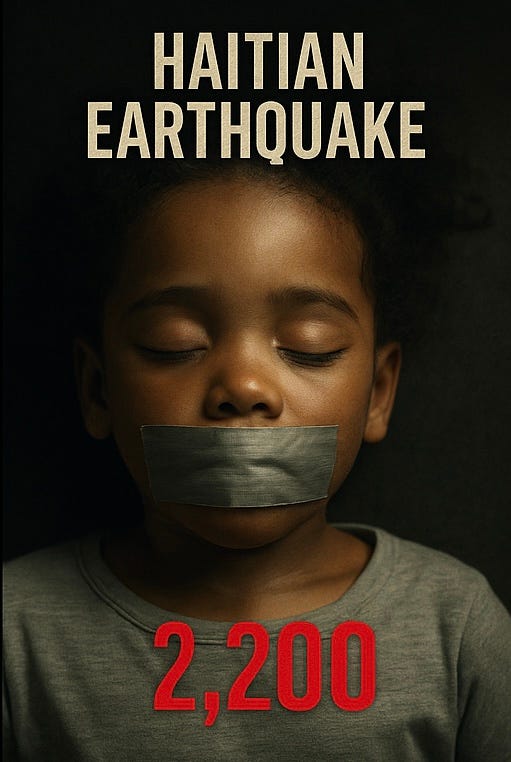
HAITI EARTHQUAKE (2021)
In 2021, the Haitian earthquake resulted in 2,200 deaths — not only from the quake itself, but because Haiti is a country that has never fully recovered from the 2010 earthquake that killed hundreds of thousands of people and shattered its healthcare system.
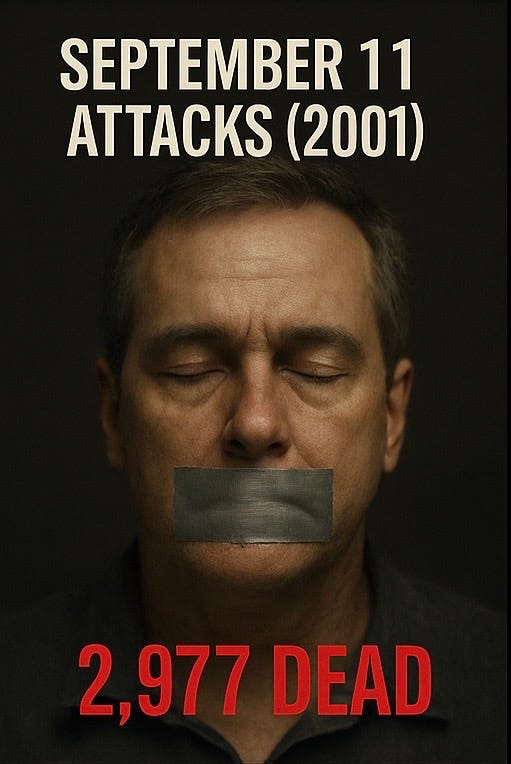
SEPTEMBER 11 (2001)
None of us can ever forget the deadliest terrorist attack in world history. September 11, 2001 saw the loss of 2,977 lives.
SUDAN FAMINE (1998)
In 1998, approximately 70,000 people died in the war-induced Sudanese famine in Bahr el Ghazal, worsened by delayed international aid. The world basically watched these people die.
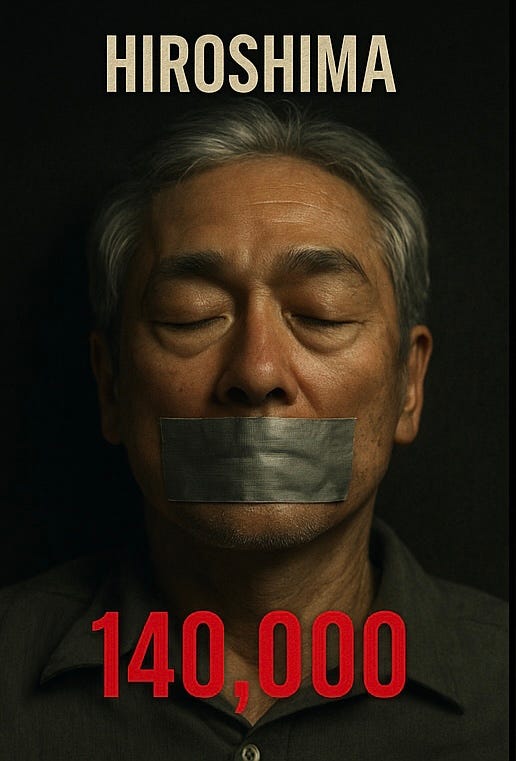
HIROSHIMA & NAGASAKI (1945)
In 1945, the United States dropped an atomic bomb on the city of Nagasaki, instantly killing roughly 74,000 people.
Later that same week, Hiroshima experienced the single most destructive weapon ever used in history — approximately 140,000 civilians killed immediately or soon after, poisoning the land for generations.
RWANDAN GENOCIDE AFTERMATH
The world knows of the unspeakable horror of the Rwandan genocide. Few discuss its aftermath, when 200,000 survivors died from cholera, starvation, and disease in refugee camps.
COVID-19 IN SUB-SAHARAN AFRICA (2020–2024)
From 2020–2024, the COVID-19 pandemic ravaged Sub-Saharan Africa. Estimates vary, with the loss of life coming around 280,000–330,000 people.
PART III — THE SHUTDOWN
On January 20, 2025, upon inauguration, Donald Trump made a decision that has led to the largest preventable humanitarian death toll attributed to a single government action in our nation’s history. Peer-reviewed estimates confirm that this decision has caused more loss of life than every military combat casualty of every American war since the birth of our nation—combined.
Experts have already forecasted that the death toll will only increase — exponentially — if nothing is done to stop it.
Donald Trump returned to office and signed Executive Order 14169, “Reevaluating and Realigning United States Foreign Aid,” a document that described a “90-day pause” framed as a review for “programmatic efficiency” and alignment with U.S. foreign policy.
It most certainly was not a shutdown.
State Department messaging mirrored this narrative with public statements emphasizing a temporary review and reassurances that humanitarian work would continue, insisting that all lifesaving programs would be protected through waiver mechanisms.
To implement the new EO, Trump unleashed Elon Musk’s Department of Government Efficiency (DOGE).
And DOGE went on to savagely and efficiently behead USAID.
The aftermath was immediate and ruthless:
The shutdown instantly severed financial systems, freezing all deliveries and waiver approvals. Cold chains failed, spoiling critical blood and vaccine reserves.
Essential medicines, antibiotics, nutrition packets, and malaria nets sat unused in warehouses, unable to move, while health workers faced empty shelves and no directives.
Internal directives froze operational ability, culminating in the termination of approximately 10,000 programs in a single sweep between February 24–27.
World Food Programme funding froze immediately, cutting food lifelines for millions and causing several countries to slide into famine conditions. School feeding programs and water support vanished; one million people in the Democratic Republic of the Congo lost basic access almost overnight.
THE RETURN OF PREVENTABLE PLAGUES
HIV/PEPFAR Disaster: The shutdown cut off life-saving Antiretroviral Therapy (ART) for 20 million people—one in three people on HIV medication worldwide.
Mass Casualties: Viral rebound led to catastrophic surges in opportunistic infections. An estimated 40,000 HIV patients died by April after only 30–40 days without medication.
Resurgent Diseases: Measles and polio resurged after immunization systems collapsed. TB medication stockouts became critical in multiple regions.
Malaria Surge: Cases were projected to rise by 12–18 million due to undelivered nets, diagnostics, and treatments.
Abandoned Outbreaks: 400 mpox patients were abandoned in a DRC ward when emergency outbreak programs suddenly stopped, simultaneously eliminating crucial disease surveillance networks.
THE HUMAN TOLL — A COMPLETE BREAKDOWN OF CARE
Birth centers, maternity wards, and emergency obstetric units vanished. Maternal deaths and stillbirths skyrocketed as women in labor were forced to travel hours for help with nowhere left to go.
Oxygen-dependent patients were discharged, forcing families to search for cylinders in informal markets.
Children died walking hours through heat toward cholera treatment after nearby clinics closed. A child recovering from heart surgery was left stranded when their clinic shut down.
Women’s centers, domestic violence shelters, and referral networks shut down.
Rape kits ran out, leaving sexual assault survivors with no way to collect forensic evidence, emergency contraception, or trauma care.
PART IV — THE NUMBERS
As of November 30, 2025, the shutdown of USAID has killed approximately 678,403 people.
That is almost five times the civilian death toll of the atomic bomb in Hiroshima.
It is the equivalent of more than 225 September 11 attacks.
It is more than 300,000 lives above the entire recorded COVID-19 death toll in Sub-Saharan Africa.
It matches the civilian loss of nearly 380 Hurricane Katrinas.
And it is already more people than all U.S. soldiers killed in battle in every major American war since the birth of the nation — from the Revolutionary War and the War of 1812, through the Civil War and World Wars I and II, through Korea, Vietnam, the Gulf War, the Iraq War, Afghanistan, and every conflict in between — combined.
Since late January, the pace has averaged one death every 39 seconds — the human equivalent of six fully loaded Boeing 747s crashing with no survivors, every day.
AMERICAN WARS & MILITARY DEATHS ON THE BATTLEFIELD
American Revolutionary War (1775-1783)...................................................................4,435
War of 1812 (1812–1815).................................................................................................2,260
Mexican War (1846-1848)...............................................................................................1,733
American Civil War (Union & Confederate (1861-1865)........................................214,938
Spanish-American War (1898–1901).................................................................................385
World War I (1917-1918)................................................................................................53,402
World War II (1941-1946).............................................................................................291,557
Korean War (1950–1953) ................................................................................................33,739
Vietnam Conflict (1964-1973)........................................................................................47,434
Persian Gulf War (1990–1991).............................................................................................148
War on Terror (Post 9/11 Operations).............................................................................6,099
Total U.S. Battle Deaths (All Listed Wars)..............................................................656,730
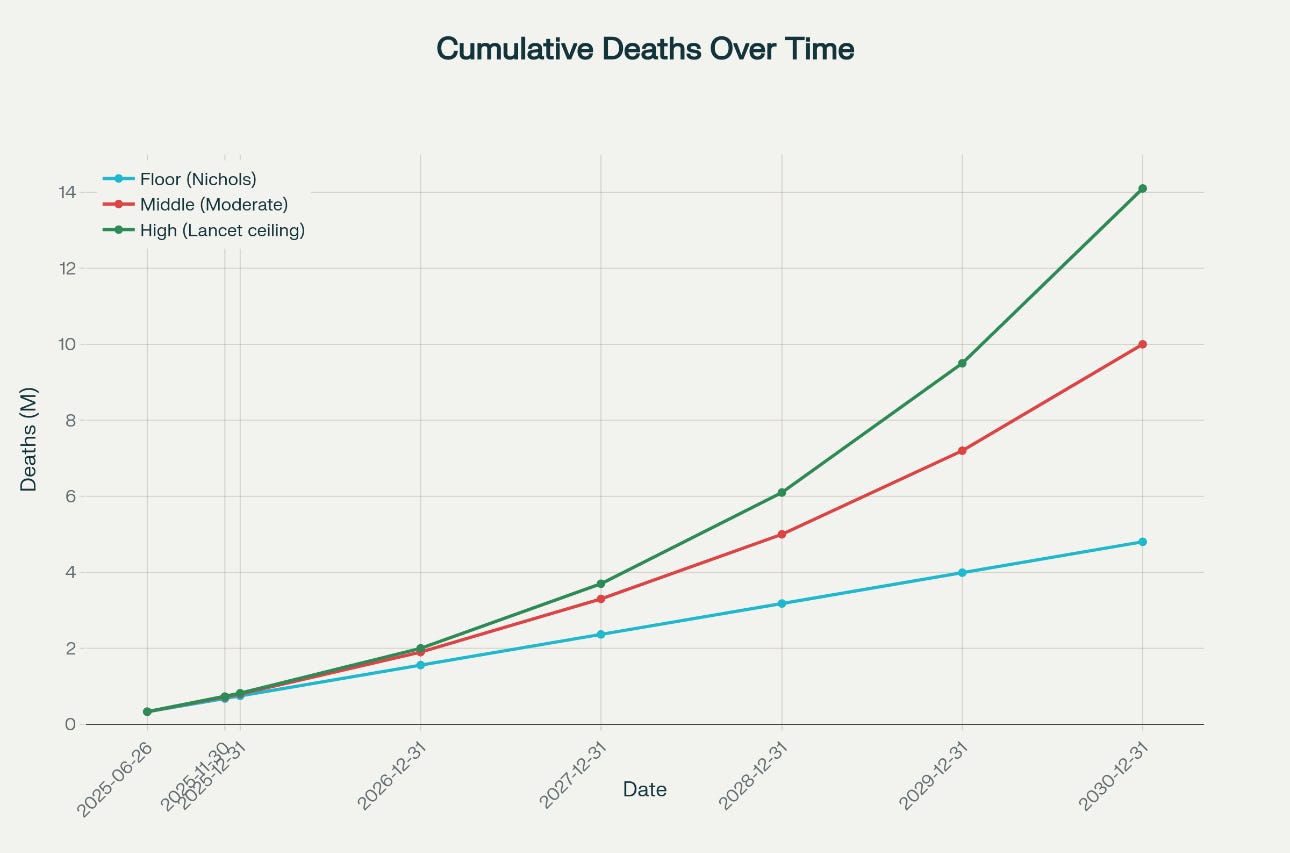
THE CHART
This chart is the first mathematically responsible way to visualize the scope of what DOGE has done.
For the first time, we have:
a peer-reviewed floor, and
a peer-reviewed ceiling.
Once you have those two anchors, you can map the entire space between them.
This is math — grounded in peer-reviewed data.
THE START DATE
Day Zero of the death count: the day Brooke Nichols launched the Impact Counter.
Every day after that has a measurable body count.
Throughout this section:
t = days since January 28, 2025
THE FLOOR
Nichols’ peer-reviewed snapshot gives the first hard point:
332,553 deaths by June 26, 2025. (t = 150)
224,575 of them children.
Driven by collapsed programs for:
HIV
TB
malaria
pneumonia
diarrheal disease
malnutrition
neglected tropical diseases
Implied rates from this 150-day anchor:
One child death every 57 seconds.
One adult death every 2 minutes.
One person dying every 39 seconds.
This is the Silent Dead floor.
EXTENDING THE FLOOR
If the first 150-day rate continues with no acceleration, the linear floor is:
D_floor(t) = 2217.02 × t
Using correct day counts:
749,000 deaths → Dec 31, 2025 (t = 338)
1,559,566 → Dec 31, 2026 (t = 703)
2,366,748 → Dec 31, 2027 (t = 1068)
3,178,929 → Dec 31, 2028 (t = 1433)
3,991,111 → Dec 31, 2029 (t = 1798)
4,803,293 → Dec 31, 2030 (t = 2163)
As of Nov 30, 2025 (t = 306):
678,403 deaths
One death every 39 seconds.
92 deaths per hour.
2,215 deaths per day.
This is the minimum.
THE CEILING
A Lancet analysis estimates:
14,100,000 excess deaths by 2030.
4,500,000 of them children under five.
Driven by collapse in:
maternal and neonatal mortality
obstetric emergencies
stillbirths
perinatal complications
untreated chronic disease
systemic health-system failure in USAID-supported areas
On the same timeline:
t = 2163 (Dec 31, 2030)
D = 14,100,000
This is the ceiling.
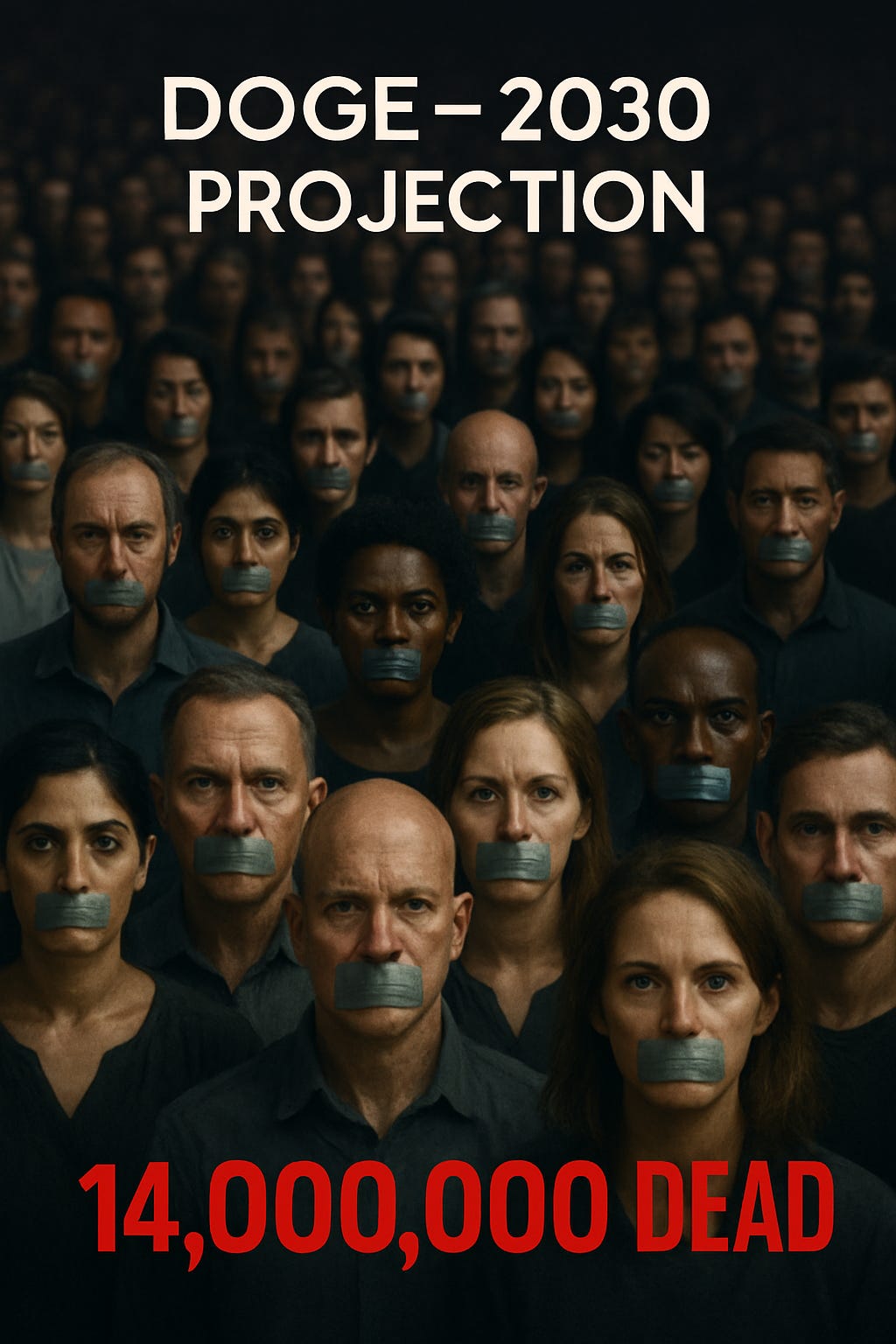
THE HIGH CURVE
To get from:
332,553 deaths at t = 150
to
14,100,000 at t = 2163
linear growth is impossible.
Only exponential acceleration can connect those anchors.
So the high band uses the unique exponential:
D_high(t) = A_h (e^{k_h t} − 1)
passing exactly through both peer-reviewed points.
This implies ~33% annual growth:
Deaths double every ~2.1 years.
This curve is mathematically forced.
THE HIGH-END EXPONENTIAL
At key checkpoints:
820,000 → Dec 31, 2025
2,000,000 → Dec 31, 2026
3,700,000 → Dec 31, 2027
6,100,000 → Dec 31, 2028
9,500,000 → Dec 31, 2029
14,100,000 → Dec 31, 2030
As of Nov 30, 2025 (t = 306):
730,000 deaths
Cadence:
One death every 36 seconds.
99 deaths per hour.
2,646 deaths per day.
THE MIDDLE PATH
Moderate acceleration, defined by:
same June anchor: 332,553 at t = 150
10,000,000 deaths by t = 2163 (2030)
This produces a middle exponential always between floor and ceiling:
800,000 → Dec 31, 2025
1,900,000 → Dec 31, 2026
3,300,000 → Dec 31, 2027
5,000,000 → Dec 31, 2028
7,200,000 → Dec 31, 2029
10,000,000 → Dec 31, 2030
As of Nov 30, 2025 (t = 306):
710,000 deaths
Cadence:
One death every 37 seconds.
97 death per hour.
2,320 death per day.
PART V — THE RECKONING
I get it.
It’s a lot.
It’s too much.
The scale of it — the numbers, the silence, the enormity of what was done — is almost unfathomable. And if I’m being honest, I can even rationalize the rhetoric of people who ask Why should America have to pay so much more in than all the other countries of the world?
We didn’t ask for this role.
We inherited it.
It’s true. None of us signed up for this.
It’s not fair…but few things in life are.
Perhaps it’s the price we pay for living in the richest country in the world. I don’t know.
But I’ll tell you a few things I do know:
Fair or not, whether we asked for this or not, once it’s understood that without us, millions upon millions of the world’s least fortunate people will die when they otherwise would have lived, this obligation became our duty. And if you are still here reading these words then chances are you know exactly what I mean.
What I do know is that USAID was never charity.
It was responsibility.
It still is our responsibility.
Promises made before we were born are still promises.
Hundreds of thousands of people have died. And millions upon millions more will join them if we don’t assume the responsibility that was passed to us — not chosen, not volunteered for, but real all the same.
And no, it isn’t going to be easy.
But when have we, as Americans, ever wanted to do things the easy way?
As overwhelming as all of this is, this essay only scratches the surface. The deeper I dug, the more I understood just how enormous this story really is — how deep the well of damage goes, how wide the shadow stretches. Every layer uncovered led to another, and another, and another. Already there is material enough to fill chapter after chapter, and I intend to keep writing until enough people rise up and put a stop to this travesty.
Because what DOGE did wasn’t just catastrophic — it was surgical.
It was efficient.
It was deliberate.
And regardless of what we were told, USAID was over before most Americans even knew something was wrong.
In the next chapter, I’m going to break down exactly what DOGE did, how expertly and efficiently they took down the entire humanitarian arm of the United States.
I’m going to explain how it was all over within those first 72 hours.
Everything since then — the deaths, the outbreaks, the hunger, the collapse — has simply been the fallout from those savage early days.
Then there’s what the administration said at the time against what the administration knew at the time.
What was said under oath versus what was understood behind closed doors.
What was broadcast to the public and what was always meant to be a distraction from the inevitable.
But in the end, it all comes down to something simple:
People are dying because we turned away.
And people will keep dying if we stay silent.
The Silent Dead are beyond our help. That’s true.
But there are still millions of people who have a chance.
But if this is the only chapter in the saga that you read, I want to leave you with something that can help turn things around.
The only way we break through this — the only way we begin to make things right — is by shattering the silence and spreading the word. Share this with the people in your life who have no idea what’s happening. Share it with those who need to understand that this isn’t politics. This isn’t a headline. This isn’t a debate.
This is life and death.
We can’t trust the media to tell this story.
We certainly can’t trust this administration.
It has to come from us — We, the People.
We must make them care about this because the longer the silence lingers, the more graves are buried.
The longer we don’t act, the faster the poorest among us will be put in the ground.
Look at the clock.
The Silent Dead are begging you to not look away.
APPENDIX: Sources & Method
Data sources
All figures come from peer-reviewed excess-mortality models analyzing the impact of the USAID shutdown, along with public summaries from major universities and global-health institutions.
Floor, middle, ceiling
Floor: Extends a peer-reviewed estimate of 332,553 excess deaths by June 26, 2025.
Straight-line projection → ~678,403 deaths by Nov 30, 2025 and ~4.8 million by 2030.Ceiling: Published projections of ~14.1 million deaths by 2030, including ~4.5 million children.
Middle: A simple interpolation between floor and ceiling aimed at ~10 million by 2030.
“Every 39 seconds” & 747s
Derived from the floor: total excess deaths divided by days since Jan 28 → deaths/hour → deaths/second.
Compared to the passenger capacity of a Boeing 747 to express the daily equivalent in planes.
War comparison
Battle-death totals are standard U.S. government/historian tallies.
Their combined figure (~656,730 deaths) is lower than the conservative USAID floor as of Nov 30 (~678,403).
What’s being claimed
These are modeled excess deaths, not individual body counts.
Even the most conservative peer-reviewed models show the USAID shutdown already exceeding the deadliest decisions in modern U.S. policy — with millions more projected if nothing changes.